
Everyone wants to talk about AI in Finance. But there’s a step we keep skipping. Before Finance can become AI-driven, it has to become AI-ready. And there’s a big difference.
I spend a lot of time in finance transformation conversations, and the pattern is remarkably consistent:
- Leadership wants AI.
- FP&A wants a forecast they can defend.
- Finance wants less manual work.
Meanwhile, the underlying process is still spread across ERPs, spreadsheets, planning tools, consolidation systems and reporting solutions. That middle layer is costly, hard to scale, slow to change and difficult to manage, it is technical debt.
So, the real journey isn’t:
Excel → AI
It looks more like:
Financial Foundation → Connected Planning → Operational Drivers → Predictive Forecasting → AI-Enabled Finance
And this is where OneStream has a compelling story.
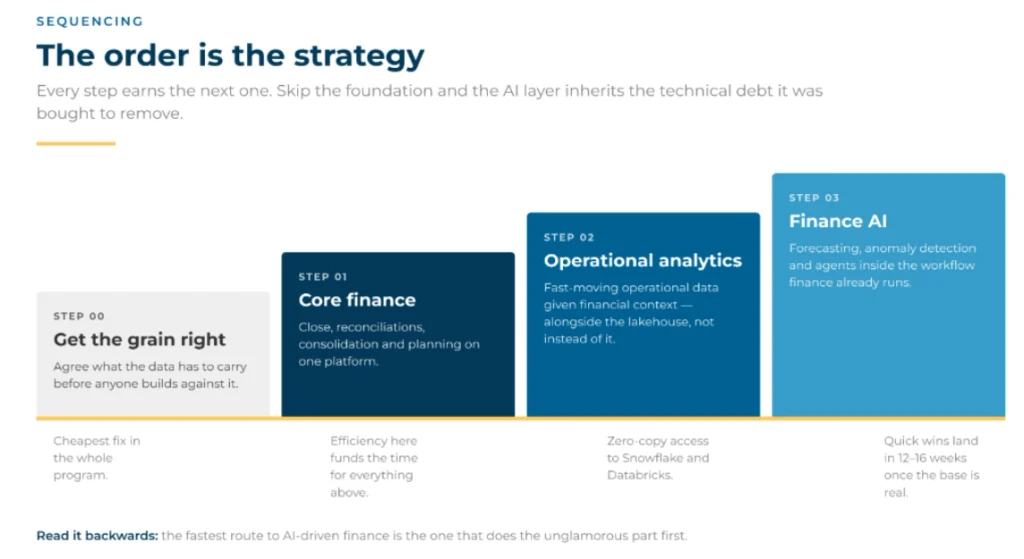
Each step funds the next one. The unglamorous part comes first.
Start With the Foundation
Before asking AI to predict what happens next, Finance needs to trust what already happened.
Actuals. Consolidation. Reporting. Workflow. Security. Data quality.
Not exciting buzzwords — but absolutely essential ones.
OneStream brings those processes together on a unified CPM platform, creating the financial foundation everything else builds from. You have to be efficient in core finance before moving on to operational analytics and finance AI.
Connect Finance to the Business
This is where Planning gets interesting.
Instead of simply asking: “What should Revenue be next year?” We start asking:
- Units × Price = Revenue
- Headcount × Compensation = Labor Cost
- Volume × Production Assumptions = Manufacturing Requirements
Now we’re not just collecting a budget. We’re modeling the business.
And OneStream supports driver-based, factor-based, zero-based and transaction-based planning approaches within the broader financial model. The rolling driver-based forecast ships with 32 pre-configured methods — zero-based, averages, headcount, percent of revenue or cost — and you can configure your own.
Get the Data Grain Right
This sounds simple. It isn’t. I was recently in a planning discussion where we had been talking about budgeting by “GL account.” Everyone agreed. Until we drew the actual accounting string.
Account was only one piece. Location, activity, department and business code were what actually determined how the expense behaved — whether it was billed directly to a customer or allocated further.
The business said “GL code.” We heard “account.”
That small distinction could have changed the entire planning design. And it reinforced something I think gets lost in the AI conversation:
AI cannot compensate for data arriving at the wrong level of detail.
This is where OneStream’s financial model matters. Extensible Dimensionality lets business units inherit the corporate chart of accounts and extend it for their own process and reporting needs, so corporate keeps control of the standard while the detail lives where the business actually needs it. And where volumes are too large to belong in a Cube at all, BI Blend provides an aggregate storage model for that reporting instead.
Detail in the right place — not everything forced into one enormous Cube.
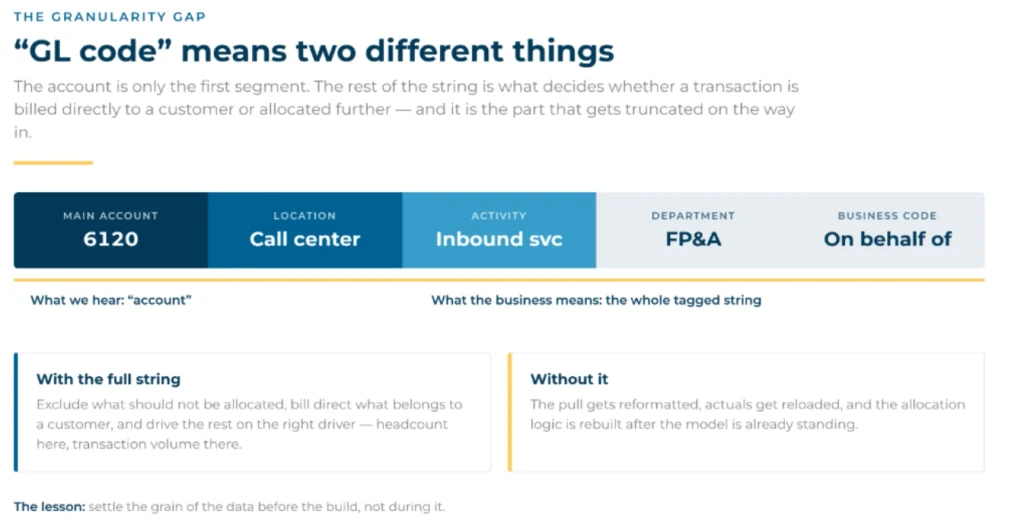
The account is only the first segment. The tags after it carry the allocation logic.
Now AI starts to make sense
Imagine AI predicts:
Units by Product × Customer × Plant
Great. But that prediction isn’t the end of the finance process.
Those units might drive:
Units × Average Selling Price → Revenue
Then:
Units → Production → Labor → Inventory → Cash Flow
That is where predictive forecasting becomes much more powerful.
The prediction becomes an input into the financial model, not a separate answer sitting beside it. The unit forecast gets multiplied by average selling price to produce revenue, and the same forecast can feed labor planning or production scheduling downstream. Underneath it, more than 25 algorithms are trained and evaluated at every intersection — a product sold to a particular customer from a specific plant is one intersection — so the best model wins locally rather than globally.
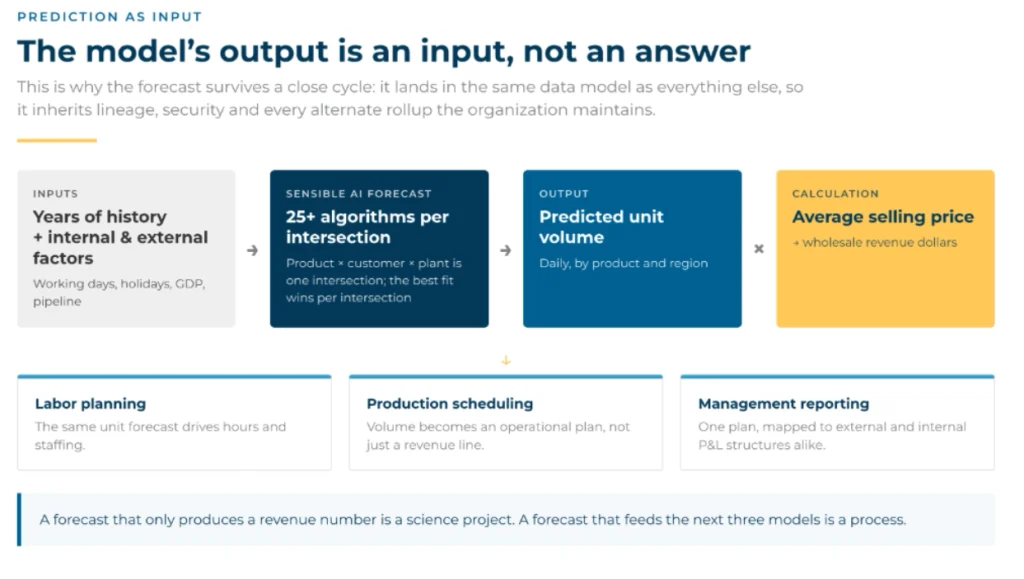
The prediction is a step in a calculation, and the same output feeds the models downstream.
Sometimes… Don’t Use AI
This may be my favorite part. Could we use AI to predict depreciation? Probably.
Should we? Probably not.
If I know the asset value, useful life, depreciation method and placed-in-service date, I can calculate depreciation. No prediction required.
The same is true for many employee costs — those come out of the HR system person by person, benefits included.
This is what a purpose-built financial engine is for: complete flexibility down to the individual data cell in how numbers are conditionally calculated, adjusted and audited, with business rules that operate at that cell level.
Deterministic problems deserve deterministic answers.
Use AI where uncertainty exists. Use calculations where the answer can be calculated.
Knowing the difference is part of good Finance transformation. Apply machine learning where it makes sense, then facilitate the rest of the process.
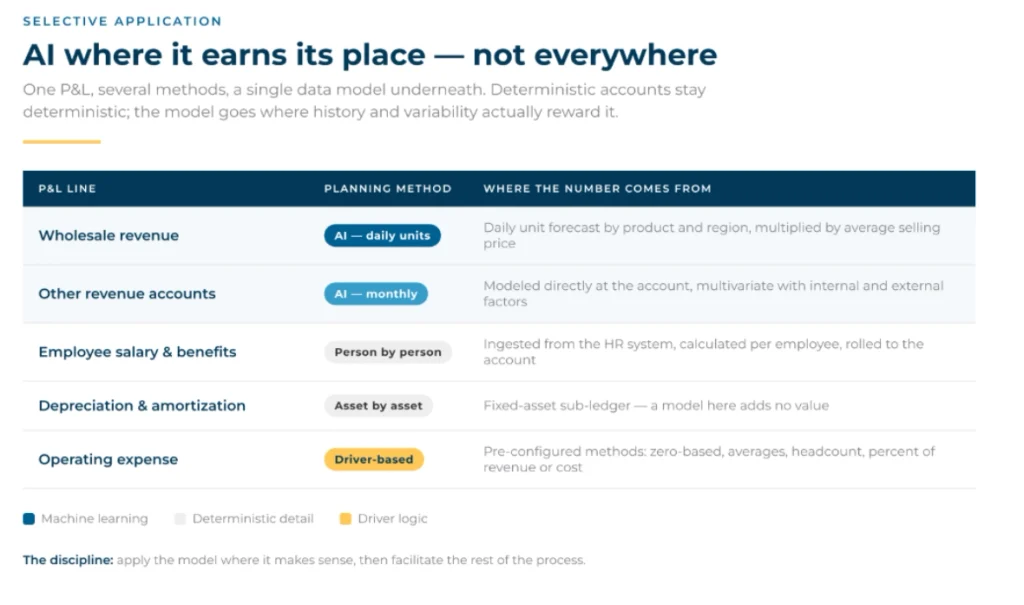
One P&L, several methods, a single data model underneath.
The Destination Isn’t “More AI”
It’s better Finance. Faster forecasts. Better explanations. More time analyzing the business and less time assembling the numbers. And eventually, a Finance organization that can move from:
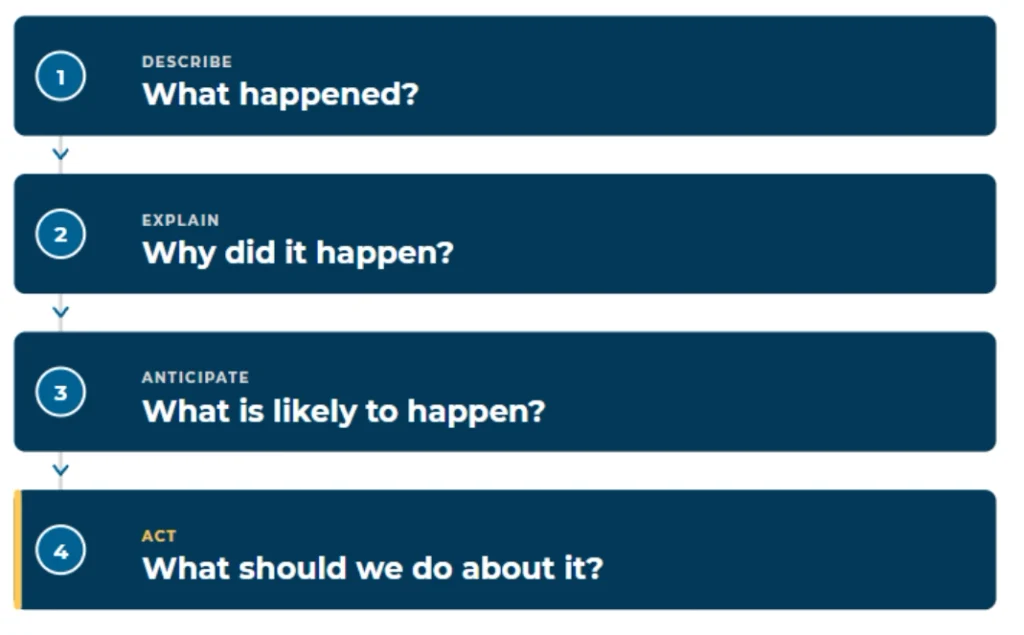
That is the part of the OneStream story I find most interesting.
It creates a path from the foundational work Finance has to do today to the predictive and AI-driven capabilities everyone wants tomorrow.
Because AI-driven Finance doesn’t start with AI. It starts with getting Finance right. That’s where BDA can help. Contact us to learn more: Contact – Black Diamond Advisory