

Few reporting requests sound simpler than they are. “I need results excluding currency fluctuations” arrives late in a design workshop, gets a nod from everyone in the room, and then quietly reshapes your scenario design, your calculation footprint, and your close timeline. Constant currency is not a hard concept, but it is one of the easier places in a OneStream application to inflate the admin workload every close and drag down reporting performance if the design is not deliberate.
Below are the patterns we keep coming back to across implementations, and the tradeoffs worth discussing with your finance team before anything is built.
Start by Defining What “Constant Currency” Means to the Business
Before touching metadata, get agreement on the question being answered. In practice, “constant currency” usually means one of three different things:
- Prior year rates – Current year results translated at last year’s rates, to separate foreign exchange (FX) impacts when evaluating year-over-year growth.
- Budget or plan rates – Actuals or forecast translated at the rate set locked into the budget, to isolate performance from FX in variance reporting.
- Latest actual rates – Prior forecast or budget re-translated at the most recent actual rates, so both sides of the comparison sit on current rates.
These are not interchangeable, and most global finance organizations end up wanting more than one. Larger organizations often maintain several re-translation bases at once: one holding budget at original rates, one restating budget at current actual rates, and one restating the prior forecast (a pattern many teams carry over from legacy consolidation tools).
A critical piece of an efficient process is defining the scope of each re-translation. Write the definitions down, including which accounts are in scope. Does every entity structure in the system need to be available, or does a more focused set work? Balance sheet constant currency, cash flow at constant currency, and cumulative translation adjustment (CTA) treatment all invite their own debates, and you want those conversations before the build, not during user acceptance testing (UAT).
Give the Constant Rates a Home: Alternate FX Rate Types
OneStream stores FX rates centrally in the system so every cube can reference the same repository. Each rate carries a rate type, and additional rate types can be added as needed. That makes this the most natural home for constant currency rate sets. A “Budget Average” or “PY Average” (prior year) type sits alongside the operational rates, loads through the same process, and is visible in the same FX cube views.
This is where every constant currency design should start. It keeps the rates auditable and avoids duplicating account or entity metadata. What a rate type does not do is store a second translated result. Something still has to perform the translation and put the answer somewhere that can be referenced in a report.
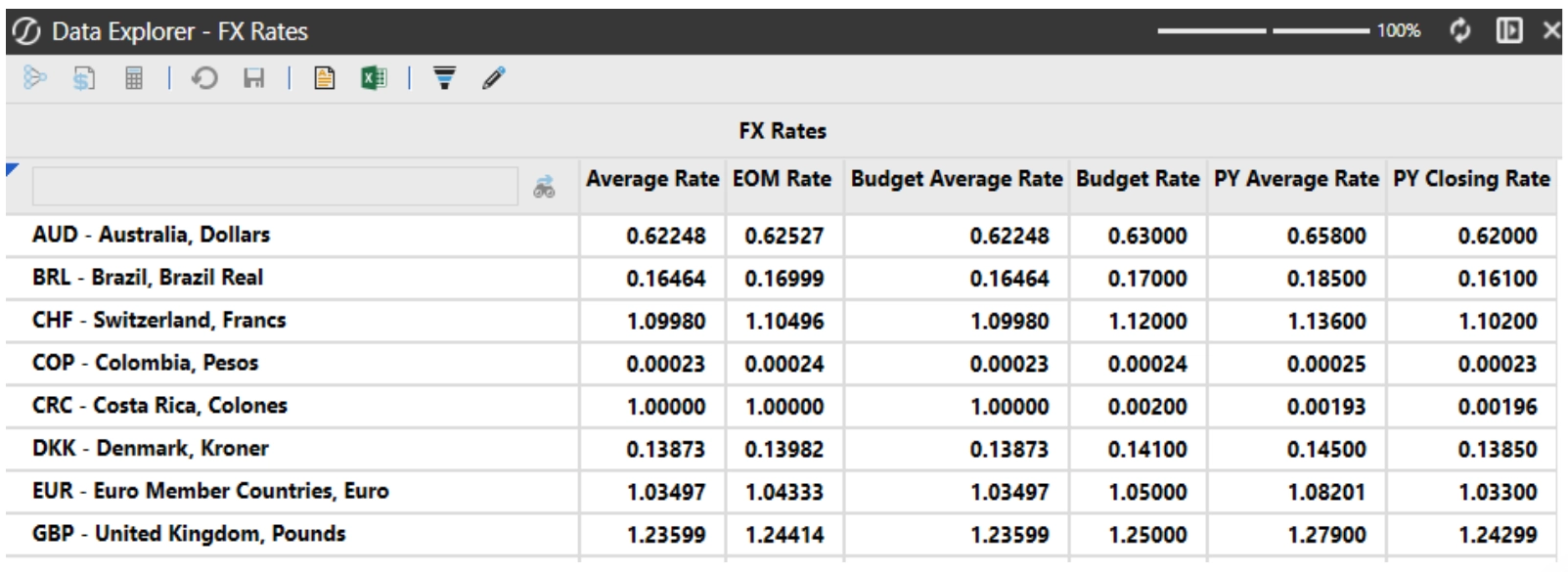
FX rates are maintained centrally in OneStream where all rates can be referenced across the application.
Let a Hybrid Scenario Do the Heavy Lifting
The usual answer to “where does the answer live” is a separate scenario holding the same local currency data translated at the desired rate set. Scenario members carry their own FX rate settings so this can be configured on the scenarios themselves.
The mistake we see is populating that scenario by hand, with a custom copy rule or a nightly export and reload quietly becoming the most fragile object in the application. Hybrid scenarios can achieve this without any additional development effort. Rather than developing custom data transfers, a hybrid scenario binds the target scenario to its source directly in scenario properties and lets the platform keep the two in sync.
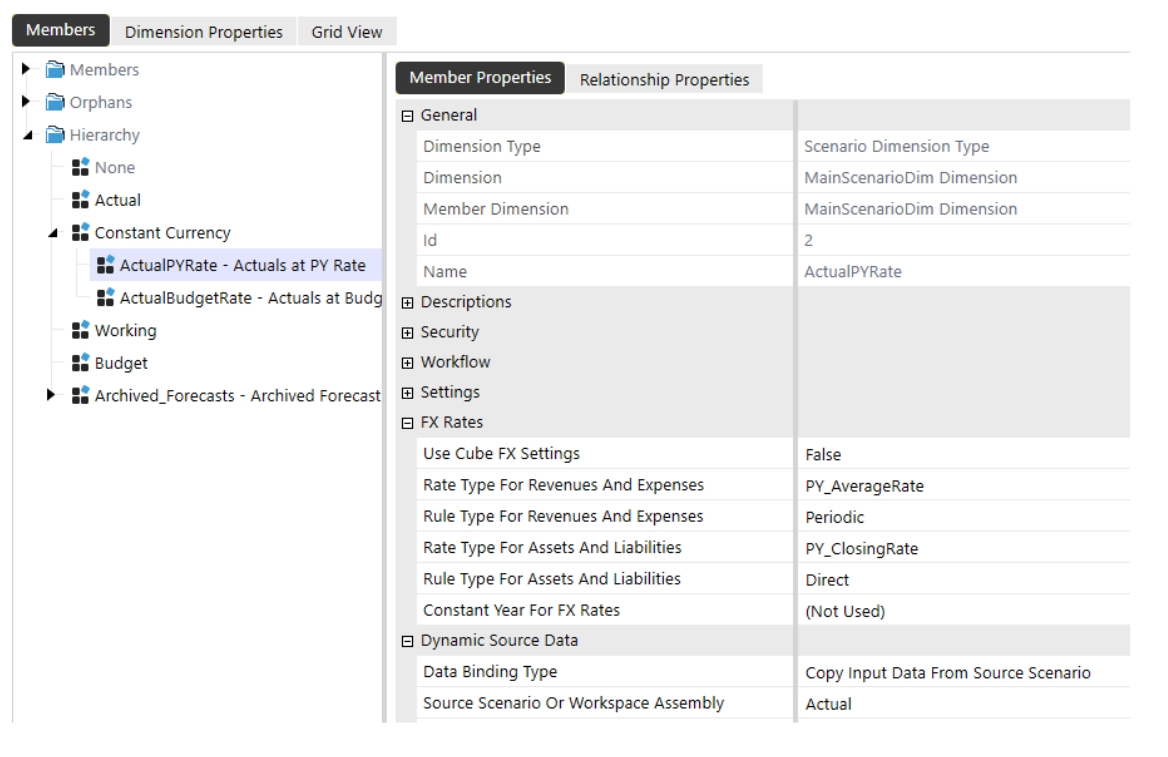
Hybrid scenarios are set up referencing specific Rate Types and Data Binding Types.
Two binding behaviors are available, and the distinction matters here. Sharing data from the source is dynamic and read-only: nothing is stored in the target and it inherits the source scenario’s calculation status, which suits a lightweight summarized view. Copying input data from the source stores a real copy in the target, and that is usually what constant currency needs. The same local currency input, translated at a different rate set, held somewhere that reports and variance analysis can consume it.
The mechanics from there are the platform’s: local currency data stored against the entity’s own currency, translated results landing under the parent’s currency member, exactly as in the primary consolidation.
Maintenance: Govern the Rates, Bind the Data
Most constant currency problems we are asked to troubleshoot are not calculation problems. They are governance problems, such as a rate that moved or a copy process nobody remembered to run. These principles can help avoid these issues before they arise:
- Own the rate calendar – Define who loads which rate types, when, and from what source, and treat the constant rate set as a locked control set, because a rate that changes silently invalidates every comparison built on it.
- Version the locked rates – When the budget is re-baselined, the old rate set still has to reproduce prior reporting. Keep it rather than overwriting it.
- Document scope for each scenario – A short write-up stating which entities, accounts, and rates are included in each scenario, along with what triggers its refresh, saves a surprising amount of support time in future years.
Performance: Know What You Are Asking the Engine to Redo
Constant currency is re-translation, so it multiplies the work of the most expensive part of a consolidation. A few good habits can help keep that effort contained.
- Shrink the data unit before you tune anything else – Hybrid data filters and pre-aggregated members let the constant currency scenario hold a smaller, summarized data unit instead of every base-level intersection. If constant currency is a management reporting view, it rarely needs full account detail, and this is the cheapest performance win available.
- Suppress zeros and mind the first run – Zero suppression keeps constant currency scenarios lean and expect the initial copy to run far longer than steady-state refreshes. The timing differences can be substantial. Plan the close timeline around the steady-state number.
- Align consolidations with data sign-offs – Scheduled consolidations for numbers that are still moving can be an unnecessary spend of processing power that could be focused on other activities.
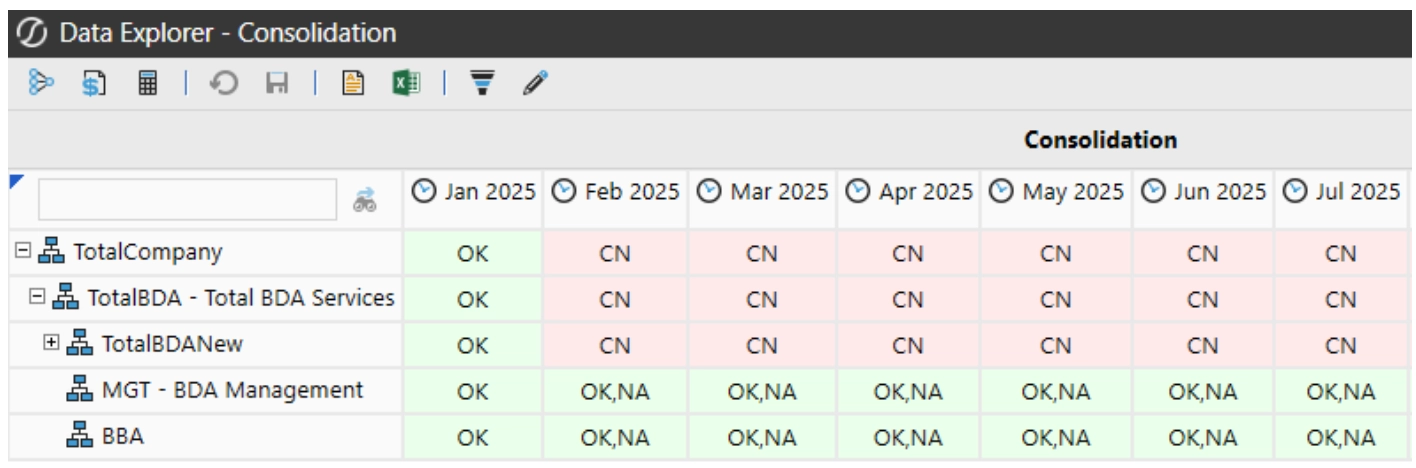
Consolidation should be managed uniquely for each constant currency scenario, limiting calculations to the most impactful data sets.
For a genuinely narrow requirement, such as a handful of profit and loss (P&L) lines in one executive pack, you can skip the stored result entirely and translate at the alternate rate type at report runtime. That is the lightest option to maintain and the heaviest at runtime. If more than a few reports need the number, or users will slice it by entity and product hierarchies, store it in a hybrid scenario.
Reporting Insights: Make the FX Effect Explicit
The point of all this work is not a second set of numbers, it is an explanation. The strongest management reports we see do not simply present results at constant rates; they bridge to them.
- Tell the full story – Reported growth, constant currency growth, and the FX effect between them provide the basis for detailed analysis to begin.
- Label the rate basis on the face of the report – “Current Year Actuals At Prior Year Actual rates” clearly defines the numbers being displayed.
- Show when the comparison base was last refreshed – A point-in-time hybrid copy is only as current as its last run, and a stale re-translation is worse than none at all because it looks authoritative.
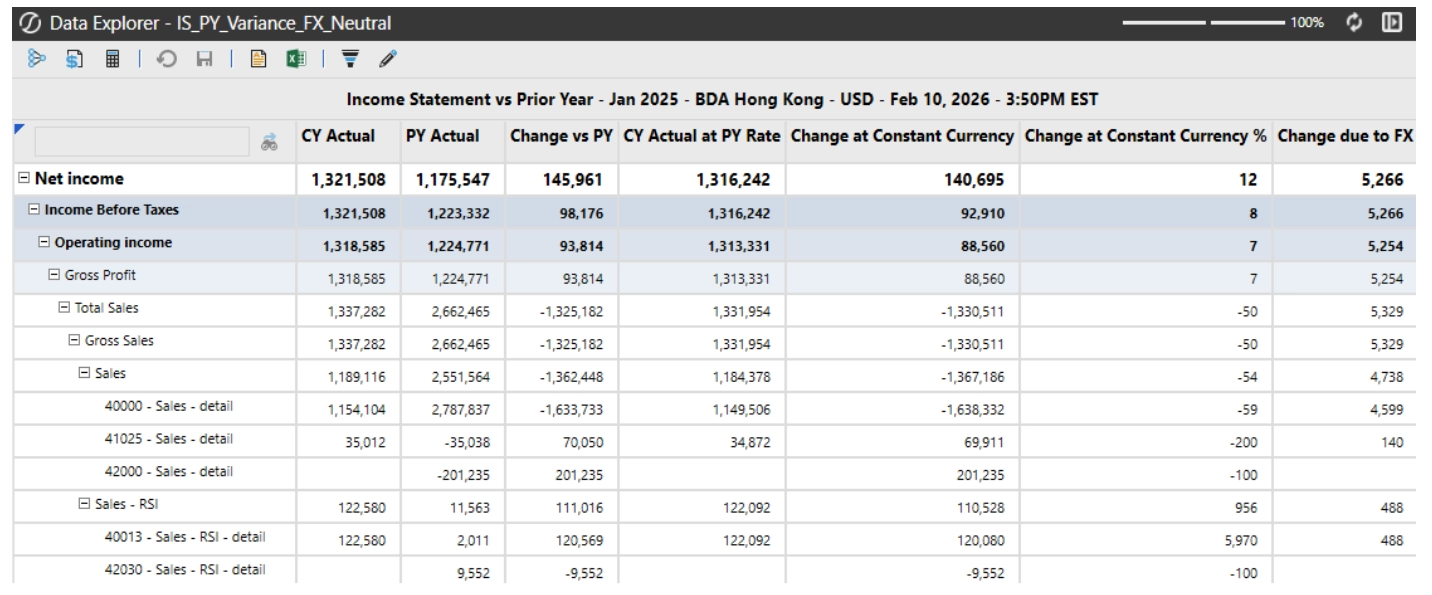
The most effective constant currency reports tell the whole story of how change due to constant currency growth and FX fluctuations combine to explain balance movements.
Wrapping It Up
Constant currency analysis is most effective when considered during upfront application design. Agree on the definition, add rate types as needed, let hybrid scenarios maintain the re-translated results, filter it to what the reports actually consume, and design the output to explain FX rather than hide it.
Applications built that way deliver reports in a single click during close. Applications that improvise often result in finance teams scrambling to produce reports days later.
Black Diamond Advisory helps finance teams get this right. Whether you are designing constant currency reporting for the first time, untangling a set of scenarios that grew organically, or trying to cut the runtime out of a re-translation that has become a bottleneck in your close, our team can assess what you have, recommend the structure that fits your reporting requirements, and implement it in your application.
If constant currency is costing your team more effort than it should, let us help you simplify it. Reach out to us today: Contact – Black Diamond Advisory