

What Finance Teams Need to Know
Most finance systems report the past accurately but struggle to explain the business. Consolidation closes on time, the statements tie, and then someone asks why EBITDA moved. The answer often takes a week and several spreadsheets.
In a midstream business, that answer depends on cost-recovery economics. Capital and operating costs are incurred centrally and recovered from shippers under contract. The difference between what the company spent and what it recovered shapes the year’s performance. Yet this logic often sits outside the planning platform in Commercial’s spreadsheets.
The OneStream planning build brought the commercial contract logic into the model. OneStream was configured so that contract terms, operating drivers, project costs, allocations, and recovery calculations work together in a controlled planning process.
Start With How the Business Earns Revenue
Midstream revenue is calculated, not simply submitted by a business unit. Contract rates establish the price. Contracted, nominated, or delivered volumes establish the quantity. The applicable month and delivery location determine which rate applies. Together, these drivers produce the revenue forecast.
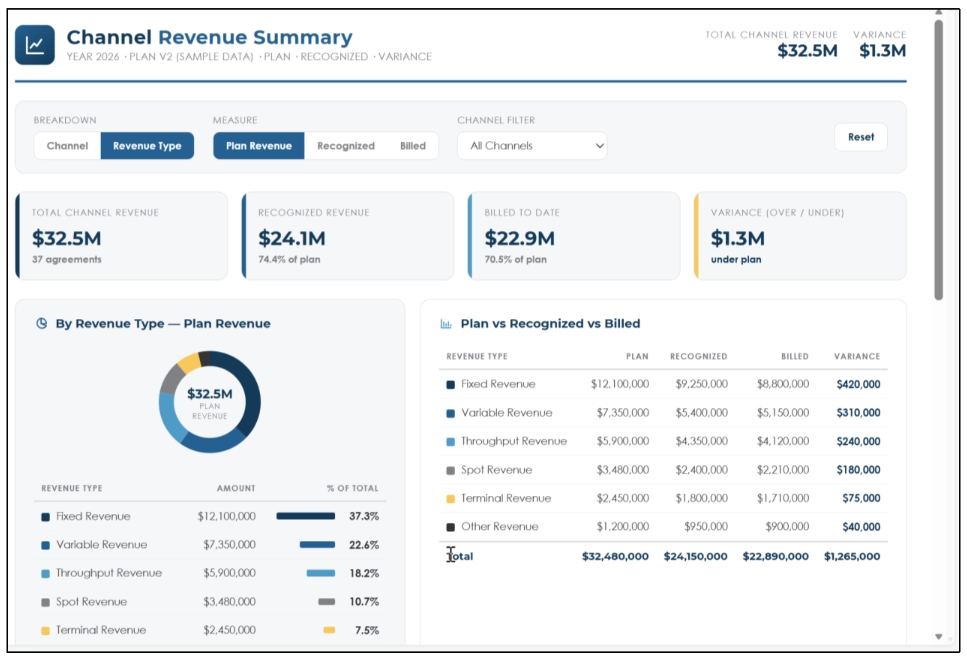
Five revenue streams calculated from contract terms, volume type, month, and delivery location
The model therefore calculates five revenue streams: fixed, variable, throughput, spot, and terminal revenue. Variable revenue is linked to the variable toll, or Vtoll. Planners maintain the contracts, terms, rate types, volumes, delivery months, and locations; the model calculates the resulting revenue.
This changes the planning discussion. Instead of debating a submitted total, teams can examine the rate, volume, timing, and location assumptions that produced it.
Classify Costs Before Allocation
The second design decision occurs before any allocation runs.
Departmental costs are planned in parallel. Cost calculation depends on different drivers defined for each cost type. Cost center and Business unit plays an important role in it.
Expansion and maintenance projects are classified when they are planned. Categories include growth and pipeline maintenance capital, non-routine adjustments, fixed-asset user fees, and operations and maintenance expense. Each project carries its recovery treatment from the moment it enters the model.
Once a cost is classified, recovery profiles attach only to eligible costs. Downstream allocations can then follow the correct treatment because the model already knows what type of cost it holds.
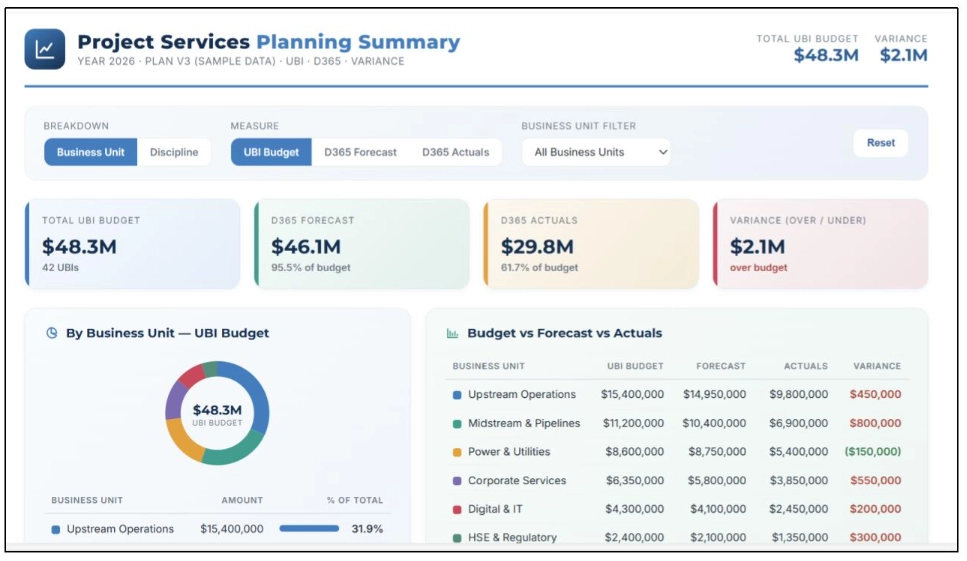
Forecasted projects identified by business units and compared with the planned UBI
Model Cost Recovery as a Sequence
Cost recovery was configured as five sequential steps:
- Identify. Flag each project with its capital or expense spend profile.
- Profile. Enter Commercial’s multi-year recovery schedule against the project so that the recovery pattern stays with the asset that generates it.
- Code. Assign costs by Business Unit, Cost Centre, and Account, using distinct business units for each recovery type.
- Allocate. Move shared costs from Corporate to the lines of business based on how the assets operate.
- Measure impact. Calculate over- or under-recovery from variable revenue, recoverable operating costs, and capital recovery.
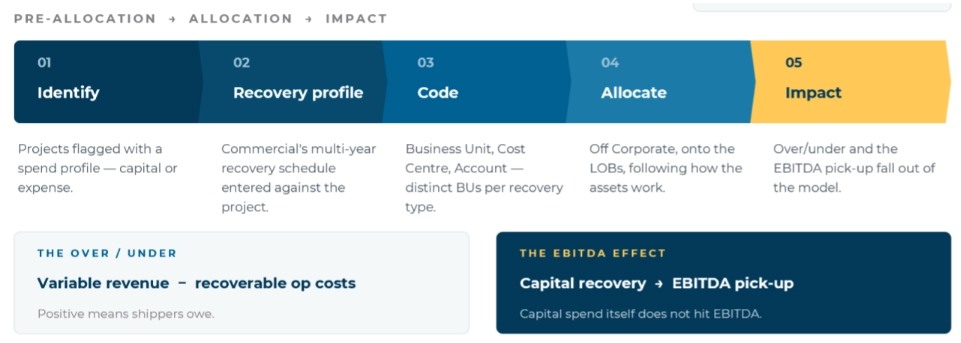
Identify, profile, code, allocate, and measure impact: five configured steps in one controlled process.
The final step is especially important for leadership reporting. Capital expenditure does not directly affect EBITDA, but its recovery does. Once the full sequence is modelled, the EBITDA impact becomes a calculated result that can be traced to the underlying project, cost, and recovery assumptions.
Cost Allocation
Allocations were designed as part of the planning model rather than as a separate month-end exercise. Shared corporate and support costs are allocated to the appropriate lines of business using defined business drivers and a controlled sequence of calculation steps. All the allocation rules, drivers, and results remain within OneStream, finance can trace each allocated amount back to its source, explain its effect on cost recovery and EBITDA, and rerun the process consistently when assumptions change.
BDA’s Allocation solution provided the framework for integrating allocations directly into the planning process.
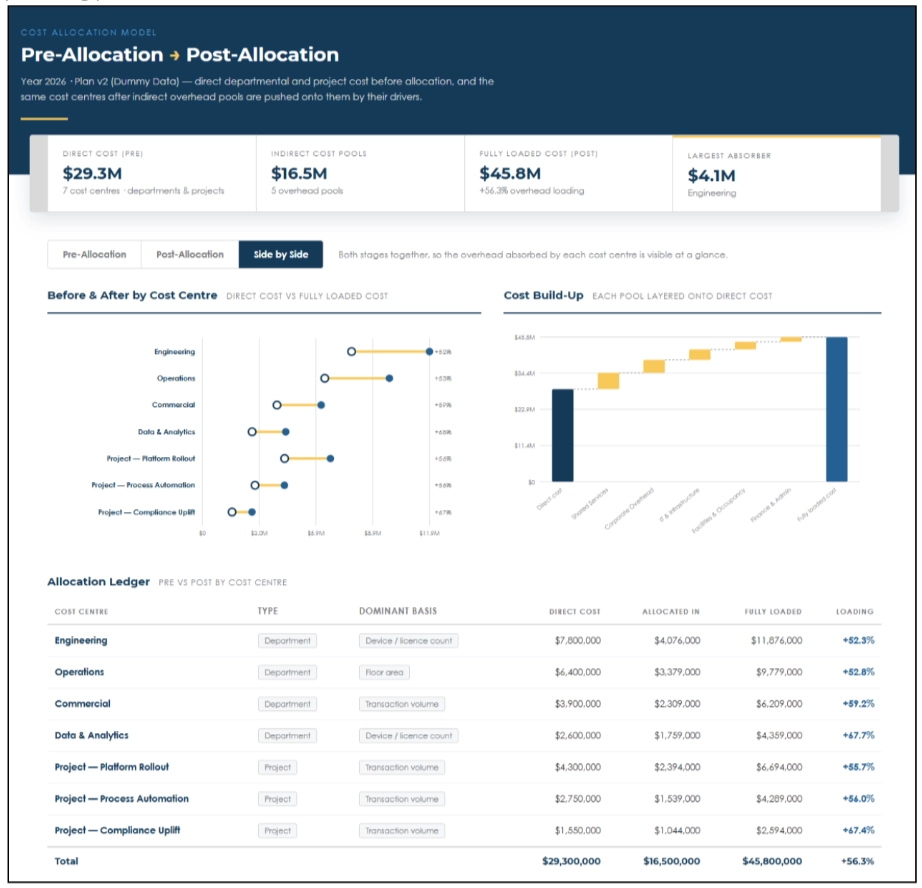
Compare pre allocation and post allocation cost side by side, costs categorized by different pools and cost build up
Power follows different logic
Power is one of the largest controllable operating costs in the business. Previously, the forecast relied on rates that were difficult to trace.
The rebuilt model uses rates and forecast methods to calculate power costs across a rolling 24-month horizon by Business Unit and Cost Centre. Planners can override any calculated cell, and both cell-level and general comments are retained with the change. The override is governed as part of the planning design rather than handled as an offline workaround.
BDA’s Accordion rolling forecast solution provided the framework for implementing this design within the existing planning process.
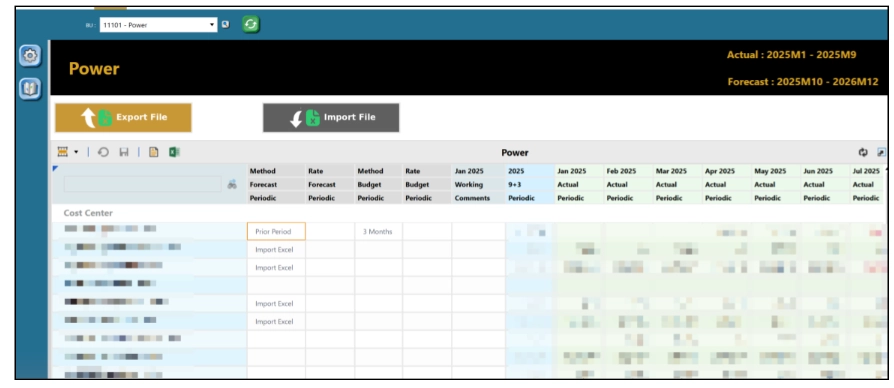
Accordion Rolling forecast for Power Model
Use OneStream Capabilities as One Application
The design combines OneStream platform capabilities with configuration tailored to the business process.
Extensible Dimensions. Actuals retain detailed Account, Business Unit, and Cost Centre members, while planners work at the higher group level appropriate for forecasting. Shared members connect the two levels and support consistent actual-versus-plan reporting.
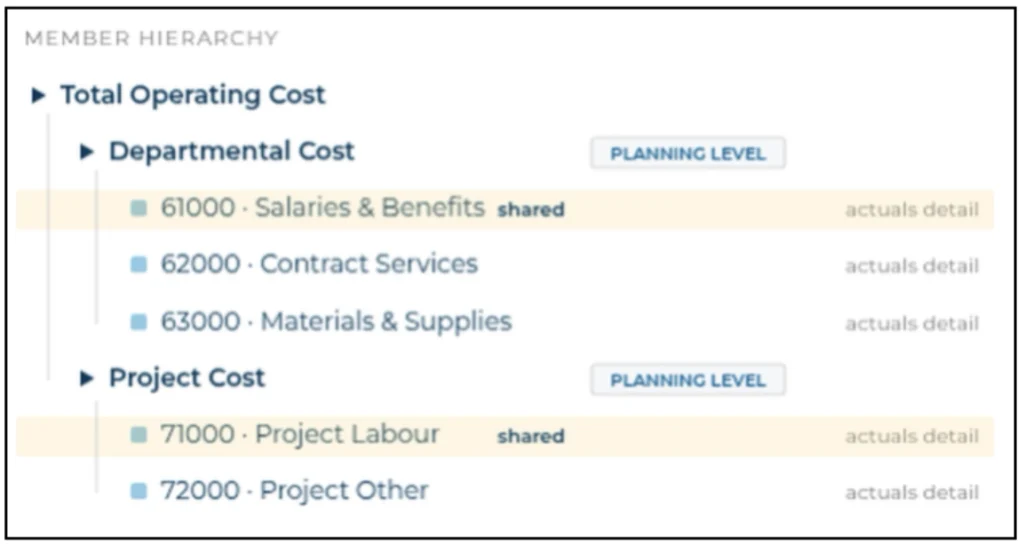
Relational Models. Contract and project details are stored and modelled relationally to handle a large volume of underlying records. Calculated results then flow to the cube for reporting and analysis.
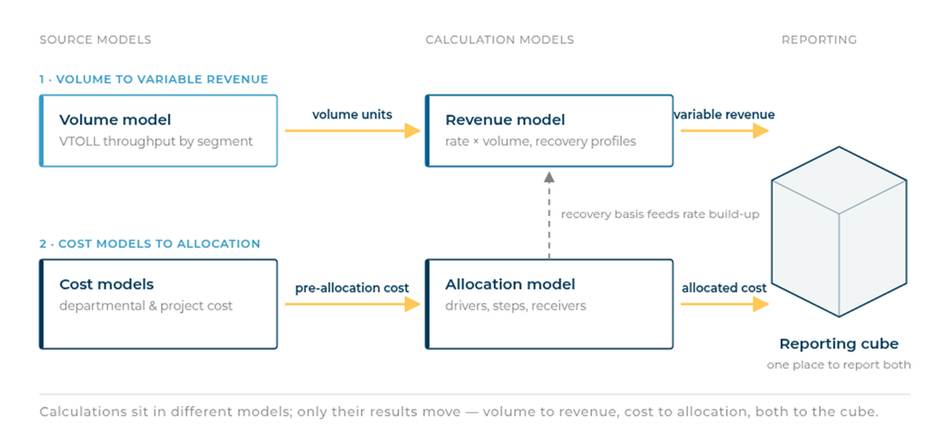
Integrated Modelling. Business rules calculate rate-times-volume revenue and recovery profiles. Allocation logic moves shared costs from Corporate to the lines of business. Although the calculations run in different models, their results flow into a common reporting cube.
Process Orchestration and Governance. Data Management sequences allocation and data-load steps into repeatable jobs, and Task Scheduler aligns them with the finance calendar. Workflow, security, and audit trails provide controlled access and traceable change history. Metadata, Cube Views, business rules, workflows, Data Management, Task Scheduler, and security operate as one application set.
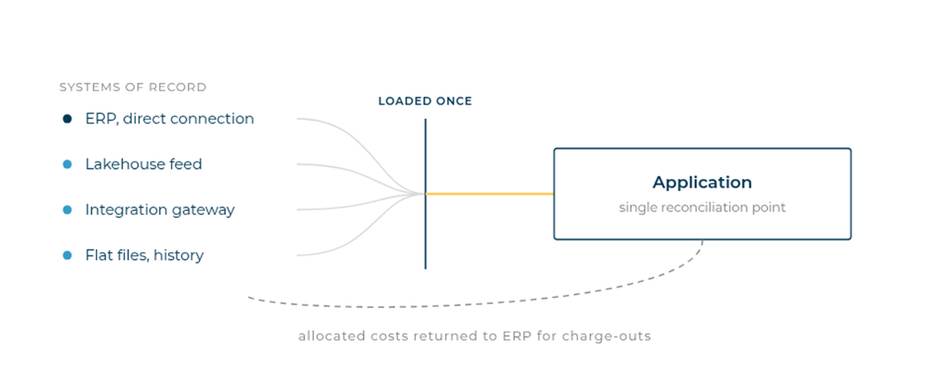
Integration. The application combines a direct ERP connection, a lakehouse feed for volume and operational data, an integration gateway, and flat-file loads for historical information. Data is loaded from the system of record once, reducing repeated reconciliation. Allocated costs can also be pushed back to the ERP for charge-outs.
Guided Reporting. Guided Reporting organizes the reporting package in a consistent framework, while the underlying Cube Views provide the data and analysis across lines of business.
What Changed for Finance
Before OneStream, finance reconstructed recoverable operating costs after the fact, rebuilt the power forecast manually each month, and lost assumption context when the cycle closed. Explaining an EBITDA movement required a separate investigation.
After OneStream, recovery is embedded in total recoverable operating costs, the power forecast rolls forward for 24 months, and overrides retain commentary and an audit trail. Finance can trace an EBITDA movement through the model to the rates, volumes, costs, projects, and recovery assumptions that produced it.
The close calendar did not change. The quality of the conversation did: the planning model now explains the movement instead of only reporting it.
Final Thoughts
Midstream planning sits at the intersection of commercial agreements and asset operations. Contract rates, volumes, project spending, power costs, recoveries, and allocations ultimately contribute to the same financial results. OneStream provides a common platform for connecting these moving parts without losing the detail, controls, and business context behind the numbers.
The real advantage is having the assumptions, calculations, workflow, commentary, and reporting operate on the same foundation. A planner can update a rate or volume assumption, follow its impact through revenue and cost recovery, and explain the resulting EBITDA movement without rebuilding the analysis outside the application. Guided Reporting makes those results easier to access and analyze across the dimensions that matter to the business.
For a midstream company, the test is whether the application reflects how the company earns revenue, operates its assets, and recovers its costs. When it does, finance can use the same governed model to prepare the forecast, review performance, and answer leadership’s questions. That is the practical value of OneStream in a midstream environment.
Want to learn more? Book a demo with Black Diamond Advisory here.