

The Revolving Compliance Door
The last few years in the compliance reporting space have been hectic. Pillar two tax rules and the move towards mandatory ESG reporting have detracted many companies from the focus of preparing for the changes which IFRS 18 brings, until now.
As companies finally wean themselves off of the pre-IFRS 16 views that some have been holding onto for nearly 10 years now, a new player enters the mix: IFRS 18.
For those hot off the battlefields of competing compliance priorities, here’s the overview of IFRS 18:
IFRS 18 Presentation and Disclosure in Financial Statements replaces IAS 1 and applies to annual reporting periods beginning on or after 1 January 2027. Earlier application is permitted. The standard introduces a new structure for the statement of profit or loss, disclosures for management-defined performance measures, and stronger requirements for grouping information in financial statements.
The real kicker around the introduction of IFRS 18 is regarding retrospective reporting periods:
IFRS 18 is applied retrospectively. At first application, entities provide a line-by-line reconciliation for the comparative period between the amounts previously reported under IAS 1 and the restated IFRS 18 amounts. Interim reporting in the first year of application also includes specified comparative reconciliations.
Your current reporting period will be required to be disclosed under IFRS 18.
You Get Extra Bonuses
To align with the new requirements under IFRS 18, there are also amendments to the following standards: IAS 7 Statement of Cash Flows, IAS 33 Earnings per Share and IAS 34 Interim Financial Reporting.
What’s the Go?
At a high level, there are 3 areas of change which IFRS 18 delivers.
Change 1: New Categories and Required Subtotals
IFRS 18 requires income and expenses in the statement of profit or loss to be classified into five categories:
- Operating — the residual category for income and expenses not classified in another category, subject to the Standard’s requirements.
- Investing — including specified income and expenses from assets that generate returns individually and largely independently, and from certain investments.
- Financing — including income and expenses from liabilities arising from transactions involving only the raising of finance, plus specified interest and similar effects on other liabilities.
- Income taxes — income tax expense or income within the scope of IAS 12/AASB 112.
- Discontinued operations — as defined by IFRS 5/AASB 5.
Two defined subtotals are also required: operating profit or loss, and profit or loss before financing and income taxes.
IAS 1 v IFRS 18 statement of profit or loss example:
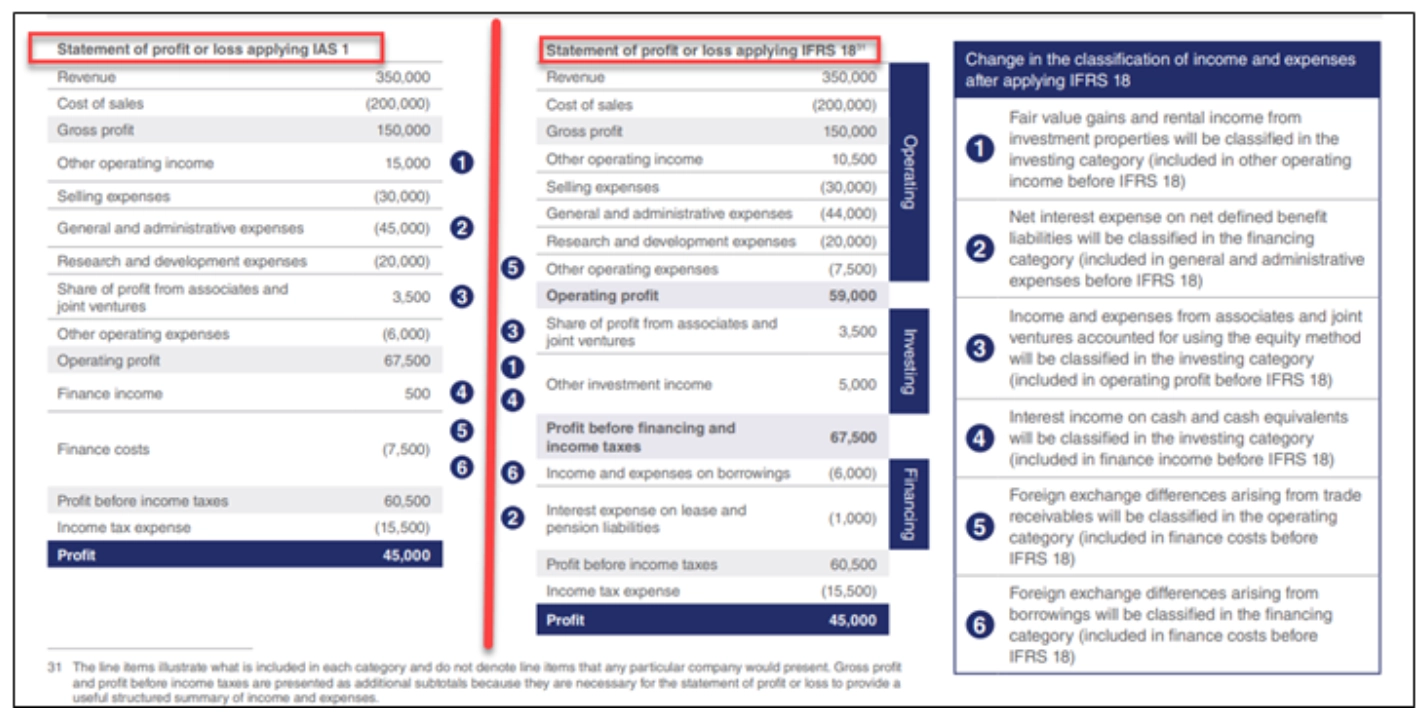
The two defined subtotals naturally segregate the operating, investing and financing categories. While the subtotals themselves may not faze many on the surface, the categorization of revenue or expenses may pivot from IAS 1 to IFRS 18 based on the definitions.
From an operational perspective, will department managers be happy to cop that anything non-investing or non-financing is an operational cost? – Good luck! With the change in statutory view there is another view to consider. Many companies may be facing the challenge of how to align the management view with the IFRS 18 view – is a pre and post-IFRS 18 view required or a re-set of the current management view?
A Challenge for the Lucky Ones
The category for some items depends on the entity’s specified main business activities. An entity assesses whether investing in assets or providing financing to customers is a main business activity; the assessment is based on evidence and judgement. Foreign exchange differences generally follow the category of the income or expense that gave rise to them, subject to the Standard’s requirements.
It could be that the Group, the parent and the subsidiary each have different main business activities. Effectively, the same expense needs to jump between operating, financing or investing based on the sub consolidation node of the hierarchy. Dibs not dealing with that in Excel!
For finance teams, classification decisions need to translate into repeatable reporting logic.
Change 2: Management-defined Performance Measures
Alternate performance measures get extra official under IFRS 18.
An MPM is a subtotal of income and expenses that an entity uses in public communications outside its financial statements to communicate management’s view of an aspect of the financial performance of the entity as a whole, and that is not specified by IFRS Accounting Standards.
For each MPM, IFRS 18 requires disclosure in a single note. This includes a description of the measure and why it provides useful information, how it is calculated, a reconciliation to the most directly comparable IFRS-defined subtotal or total, and the income tax and non-controlling interest effects of items in the reconciliation. The Standard also requires explanation when an MPM is added, discontinued or changed.
An MPM reconciliation example:
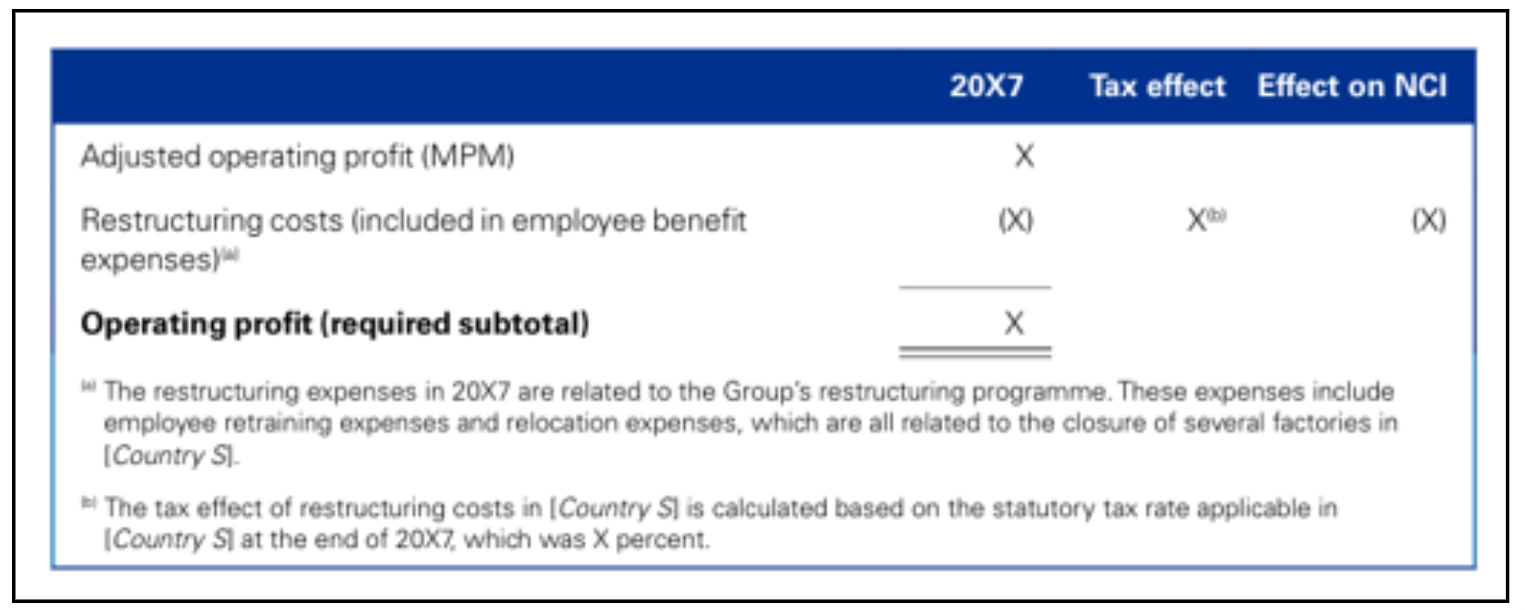
With MPMs dropping into the scope of audit, the safest bet is for official measures to reside within a system with auditable recognition, reconciliation and approval processes.
No doubt the initial focus will be on the existing MPMs, however time will tell whether the pre-defined sub-totals drive companies to start referencing a new suite of MPMs……
Change 3: Aggregation, Disaggregation and Operating Expenses
This section addresses the full extent of IFRS 18 to cover all financial statements as well as the view of what belongs in a financial statement v disclosure note. Think complete financial statement disclosure overhaul!
IFRS 18 strengthens the principles for grouping information in the primary financial statements and notes. Items with shared characteristics are aggregated; items with different characteristics are disaggregated when needed to provide material information. Labels should describe the items included, and information should be placed in the statements or notes in a way that provides a useful structured summary.
Operating expenses may be presented by nature, by function, or using a combination, depending on which approach provides the most useful structured summary. If an entity presents operating expenses by function, IFRS 18 requires a single note disclosing specified amounts by nature, including depreciation, amortization, employee benefits, impairment losses and reversals, and write-downs of inventories and reversals. The amounts disclosed can include costs capitalized into assets, so they may not equal the amounts expensed in the statement of profit or loss.
The transition from an IAS 1 financial reporting cycle to IFRS 18 is not simply a roll-forward process. Already stretched to the limits with the existing status quo process? IFRS 18 demands the assessment of whether a more streamlined, auditable and transparent reporting approach is required.
The Good News
IFRS 18 is a presentation and disclosure standard. It does not change the recognition or measurement requirements in other IFRS Accounting Standards. It changes where income and expenses are classified and what entities present or disclose about them.
What Are We Really Looking at Here?
Beyond the Presentation and Disclosure in Financial Statements lies the functional question of how the data, processes and management views can work together.
Is it naïve to think that the cut-over from IAS 1 to the IFRS 18 view of performance will be clean cut with a transitional period of 12 months? From a statutory perspective yes, operationally may be a very different story.
Practically, there are a number of downstream players to consider such as KPIs, cash flow calculations, management & budget reporting packs and left hand notes.
Overarching is the question of what if the IFRS 16’s and IFRS 18’s of the world keep coming at rapid fire pace?
Next Up
In the upcoming blog we will address how, within a OneStream environment, the challenges presented by IFRS 18 can be addressed by finance teams.
Not sure where your reporting and consolidation processes stand ahead of IFRS 18? Contact Black Diamond Advisory to talk through your readiness: Contact – Black Diamond Advisory