

We’ve all seen Project Meltdown. It often starts as a small tremor during a solution preview or a test cycle, but it quickly escalates. A key stakeholder realizes the solution doesn’t meet their core needs; a resource suddenly burns out because they’re balancing a month-end close and a system build; or conflicting opinions between departments stall the project entirely.
In the world of OneStream EPM implementations, these meltdowns aren’t inevitable. They are usually the result of “social architecture” choices made (or ignored) in the first 30 days. To keep your project on track, you need to focus on these four pillars.
1. The Right Humans: Analytical Depth Over “Availability”
In the first 30 days, the most dangerous resource strategy is picking people based on who has a light calendar.
- The “Unicorn” OneStream Admin: Don’t just hire a technical admin. You need someone who speaks “Accounting,” understands the flow of data across your ecosystem, and can translate technical constraints into business logic. The OneStream administrator training will be a great starting point for this person early in the project.
- Recruiting for Analysis, Not Tasks: When staffing your team, look for analytical depth. Even a seemingly simple task like data validation requires someone who doesn’t just reconcile numbers but can analyze why a variance exists and define outcome options. If you can’t afford to lose them from the business for a few months, they are exactly the people you need on the project.
- The Internal Change Champion: Nominate someone early who knows the stakeholder landscape and the company culture. Their job isn’t to make everyone happy — it’s to reaffirm the project’s objectives and ensure the “Why” (the transformation) doesn’t get lost in the “How.”
2. The Realistic Roadmap: Combatting “Capacity Blindness”
Once requirements are wrapped, many teams dive straight into the build. This is a mistake. You must pause to look at the real-world calendar.
- The Internal Walkthrough: Conduct a deep-dive walkthrough of the timeline that includes reality checks: year-end close cycles, other project or IT initiatives, and even personal vacations or commitments.
- Partner Pulse Check: Have your implementation partner sit in on this. They’ve seen these pitfalls before and can provide the “sanity check” your internal team might be too optimistic to see.
- External Dependencies: OneStream doesn’t live on an island; it is a platform. Consider teams outside of core Finance. If IT or HR or Tax is undergoing a system or process change at the same time, your project could be at risk. Map these dependencies now.
3. Calibrating Change: The “Absorption” Factor
A project can be technically perfect and still fail if the organization can’t swallow the change.
- Reality Over Reach: Be realistic about how much change your team can absorb. This should directly influence your phasing and scoping. It is better to deliver a rock-solid Phase 1 than a “complete” solution that no one knows how to use.
- Lead with the “Why”: People aren’t motivated by “improved metadata management.” They are motivated by the outcome. Focus the narrative on the “Why” – perhaps it’s giving people their weekends back during month-end. When the “Why” is clear, the team stays motivated through the long hours.
4. Unified Governance: Guarding the “Single Source of Truth”
OneStream is a unified platform, meaning a decision made by one team can inadvertently ripple through others.
- The Design Authority: Establish a rigorous Steering Committee and Design Authority in month one. This is your engine for breaking deadlocks when stakeholder opinions conflict.
- Implementation Partner Feedback Loop: Review your findings and internal constraints with your partners early. They do this all the time; let them guide you through the cultural and technical “mines” they’ve navigated in the past.
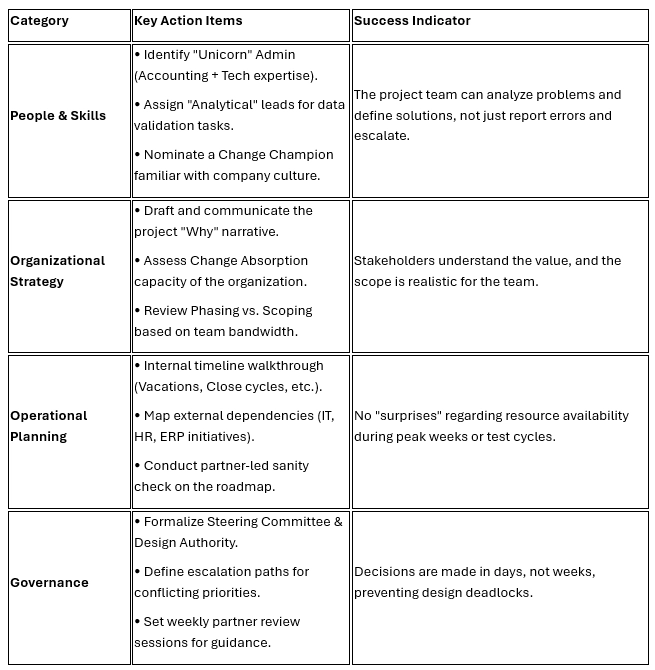
Bonus: The OneStream “Month 1” Success Checklist
All of this can seem like a lot to juggle. Use this checklist as your foundational “To-Do” list for the first 30 days to ensure you are building on solid ground.
The Bottom Line
Success in a OneStream implementation is about Social and Structural Architecture. If you haven’t identified your key players, mapped your resource dependencies, and established a “Why” by Day 30, you aren’t just managing a project; you’re managing a future crisis.